26 November 2006

A good full day

Well, I've just spent the entire afternoon walking around Jerusalem taking some neat pictures for you all to see. Phew! I'm beat.
The pics should be up soon, either tomorrow or Tuesday. In the meantime, feel free to check back in the next 24 hours for a new post overviewing a bit of the current political situation here (as much as I know of it, which isn't much).
Ulpan was great today. I didn't know any of the words they taught us today, which means....I learned new words!!! Yay!!
Previously, there has been maybe two or three 'new' words a week, which I didn't know. Now we are starting to learn words and grammatical constructions that are new for me, and this, God willing, may be the beginning of the end of my 'please go faster and teach me something new because I am bored!!!' problem in ulpan. It had better be; I'm paying for it, right?
Welp, see ya later!


Site Meter

18 November 2006

Feelin' Better!

Boy, someone must have been talking to the big guy upstairs for me because I feel sooo much better!! Maybe it was the ten hours of sleep two nights in a row....
So, don't worry. I'll be up and ready to go tomorrow and ready to keep you up to date on my life without having to blow my nose after typing each word.
Shavua tov is what we say in Israel on Saturday night and Sunday morning after the Sabbath. It means "A good week".
So, Shavua Tov!
Later


Site Meter

17 November 2006

That's so sick!

So, I was planning on posting something new today, Friday being the only day where I can sit and think and write, that isn't Shabbat. Unfortunately, the universe seems to have had different plans.
I picked something up.
My head feels like it is about to explode. The pressure is centered around my eyes - sinus stuff - and my nose is running like a fugitive with hounds on his trail. My eyes are burning and watering, and clear liquid keeps dripping down the back of my throat, making me cough, which makes my eyes water more. Then I sneeze, and it begins all over again.
Sleeping is a whole other deal. When I woke up this morning, my nose was stuffed solid with godknowswhat.
So, keep me in your thoughts and prayers. Hopefully, since I have some time to rest and sleep more this weekend, I'll be better for class on Sunday.


Site Meter

15 November 2006

Life on the Other Side - In Pictures!

As promised, some pictures of my first weeks in Ha'aretz ('the Land'):


This is, fortunately or unfortunately, the only physical proof (despite the possibility of using photoshop to create a semblance of reality) of my being in Israel. It was taken on my first weekend in the country at the archaeological sight of the Roman/Herodian aqueduct in Caesarea, on the Northern Israeli coast. It was built to bring water to the city of Caesarea, which was built as an administrative center by King Herod in honor of...you guessed it, Caesar (specifically Caesar Augustus, or, more formally Divi Augusti Octavianus, 'the divine Augustus, formerly known as Octavian', or something like that). My friend Nancy, who is also my landlady, took the picture as I stood on top of the aqueduct.

Here is another picture of the aqueduct, from another angle. Neat, huh? The Romans were masters of architecture and of bringing water to remote reaches of the Empire in order to facilitate a sort of globalization of the ancient world. Judea was no exception, especially because of the construction projects of Herod the Great, who is famous for being the greatest builder and developer of the Roman period, among other things.


After visiting the aqueduct, we went to the real site of ancient Caesarea. According to Josephus Flavius (the most prominent Jewish-Roman historian of the ancient world), King Herod 'built a harbor where there was none'. He literally constructed a place for ships to come in and out in the middle of the coastline, where no natural harbor existed in that area. He also built a quintessential Roman-style city, complete with an amphitheater, a hippodrome for gladiatorial games and horse races, a temple to 'Rome and Augustus', a subterranean sewer system 'which automatically flushed itself with the sea tides', and an administrative center from which the Romans would rule Judea after Herod's death. This is the site where Paul was questioned by Agrippa and Festus and requested to be tried before the emperor (as he was a Roman citizen and deserved such just treatment not accorded to non-Roman citizens) and where the first Jewish revolt against Rome (66-73 CE) began after conflicts between the Jewish and non-Jewish residents of the city erupted into violent riots. After the 20,000 Jewish residents of the city were slaughtered by the Greek residents (number probably inflated by Josephus), the city was completely Roman/Greek, i.e. non-Jewish in a Jewish land.
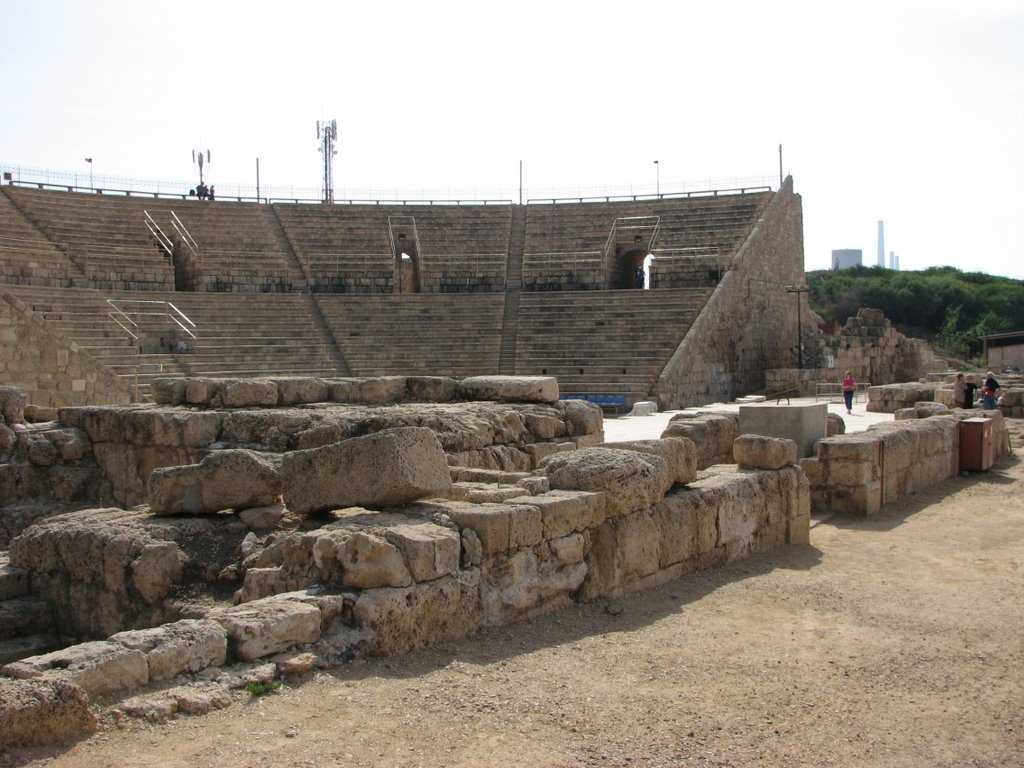
Here is a picture of the amphitheater, reconstucted and restored for modern usage:


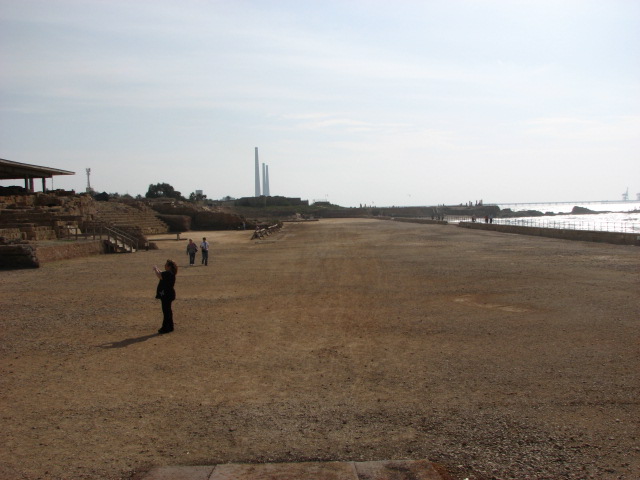
Below is a picture of the hippodrome (think horse racing scene from Ben Hur). The seats are on the left in the picture, and they faced the Mediterranean directly opposite. If you look in the middle of the track, you can see the center structure, around which they raced. The picture is taken from the starting gates.


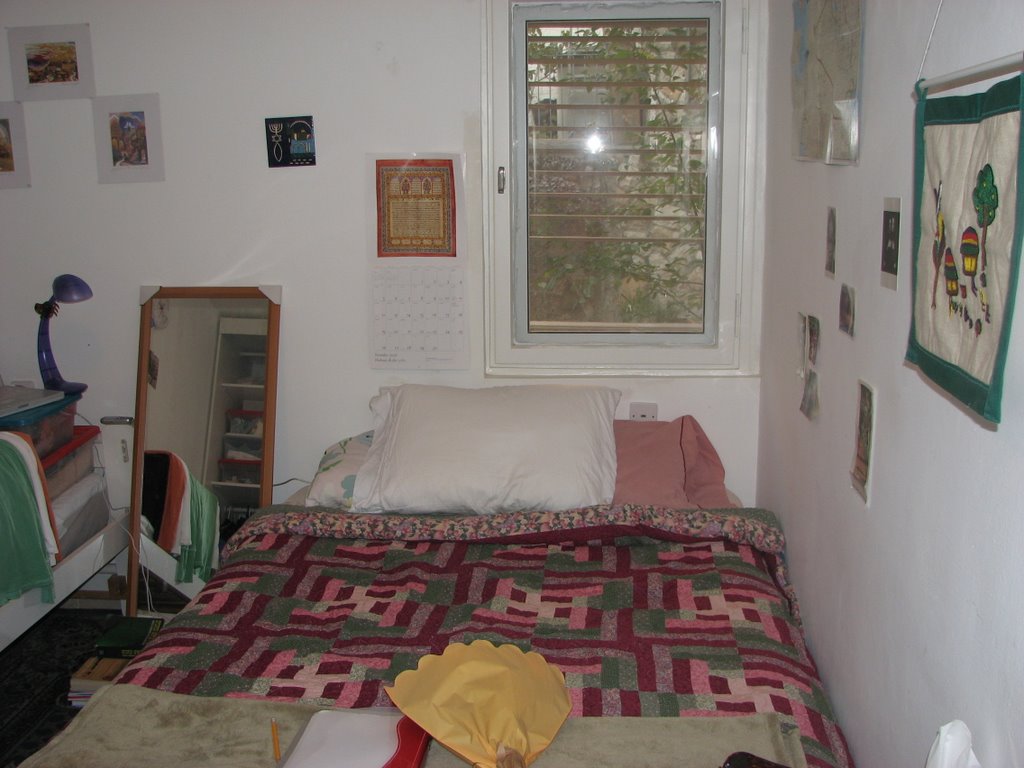
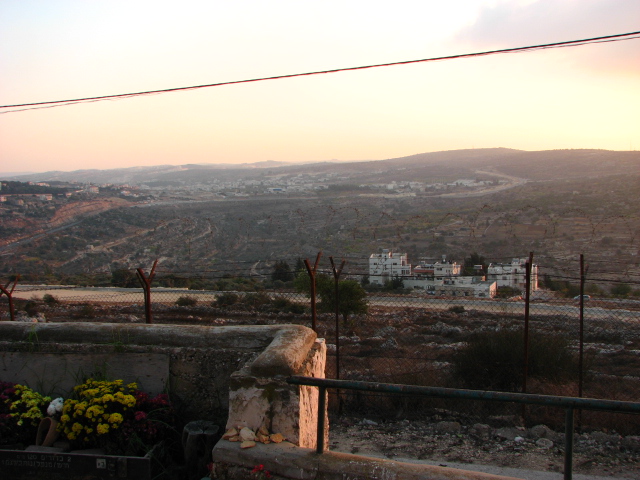
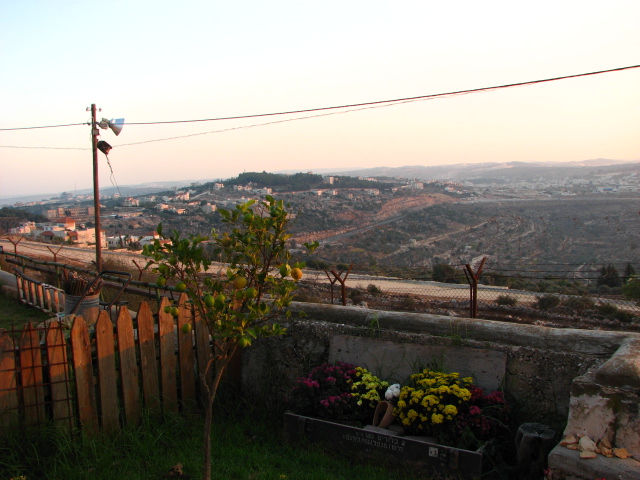
Here also are some pictures of my room and of the view from the backyard of the house in Har Gilo, where I live.


Notice the barbed wire fence. Har Gilo, technically on the Arab side of the 1967 Green Line, is a settlement which has been annexed by Israel. The town in the forefront of the first pic is Bethlehem, and Hevron (which is unclear in the picture but is a straight-shot south from B'hem) is past it. I will post more about Har Gilo later.
Well, have to get up early for ulpan tomorrow, so that's all for tonight. Later!


Site Meter

10 November 2006

One More Example

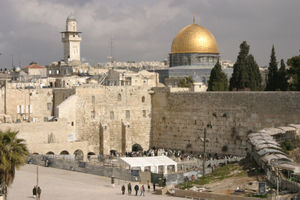
By the way, if you need one more quick and clear example of tension in J'lem...just look at the picture in the next post down (I didn't take it - still don't have access to my laptop).
Notice the Western Wall (archaically called the Wailing Wall), the holiest Jewish site in the world. Hundreds of Jews pray here every day.
Next let your eyes wander up to the big gold-plated dome above the wall. This is the Muslim Dome of the Rock, built atop the Jews' temple mount in the 600s CE. Also atop the temple mount, to the right of the Dome, although not in the picture, is the al-Aksa mosque.
When visiting the Wall at certain times of the day, one can hear the Jews praying in Hebrew, as they have done for centuries, as the Muslim call to prayer, hauntingly beautiful, echoes out from the mosque atop the temple mount.
It doesn't get much closer than that.


Site Meter

Jerusalem of Tension


There's a popular song about the City of Jerusalem called "Yerushalayim Shel Zahav" (Jerusalem of Gold).
The chorus goes: "Jerusalem of gold and of bronze and of light...etc etc etc".
You might think, at first glance, that these things are the same in the world of poetic and artistic expression. I.e. that saying 'jerusalem of gold' is the same as saying 'jerusalem of bronze', but really these things are not the same. How can something be made of gold, widely valued as the most precious metal in the world, and of bronze, a mixed alloy made essentially of copper and tin ('the tin content not exceeding 11%,', according to dictionary.com), at the same time?
It is illogical.
Either the holy city of Jerusalem is made of pure gold, bright and beautiful, sought after for centuries by princes and paupers alike, or it is made of a base metallic mixture which could include any number of alloys, so long as copper is the main ingredient.
Right??
Now, allow me to explain the point.
I have now been here, as an Israeli citizen and a semi-resident of Jerusalem for less than two weeks (11 days, to be exact), and, although I do not claim to be, in any way shape or form, an expert on these things, certain things are clear enough that one does not have to be a rocket scientist to perceive and understand.
The song holds a certain truth, essential for beginning to understand the atmosphere, the culture and the politics of this city. Jerusalem is a city of gold. It is beautiful, shiny and precious. Its white stone literally sparkles in the sun. But, just like gold, this external beauty is deceiving.
Jerusalem is not made only of gold. It has a baser nature, often lost to tourists and golddiggers stuck in the beauty of its romantic facade.
Jerusalem is made of bronze, as well. It has crime and pollution and destructively violent religious fanaticism. It has weirdos and rapists and trash everywhere (large-scale recycling has yet to make its way to the region).
From what I have seen, Jerusalem is, above all, a city of tension. It has been called a pressure-cooker. This is an understatement.
From where does the tension come? Every. direction. imaginable.
The most common relationship talked about is that of the Israelis and Palestinians or the Jews and the Arabs. To be sure, this tension exists, but it is much more complicated that that.
I have seen the tension between the religious Jews and the secular Jews, between the natural-born Israelis and the immigrants (even those who have been in the country for twenty years), between the old and the young, between men and women, between the left and the right and the moderate, and much, much more. There is tension between different sects of religious groups, Jewish and Christian (and Muslim I am sure, though I have not seen it first-hand yet). Perhaps you have been glancing at the news and have read or heard something about the gay-pride parade/rally scheduled to take place in Jerusalem at this very moment (Friday midday) which has been protested vehemently (and sometimes violently) by the haredi orthodox in Israel. This is another stark example of the tension, and this is not as simple as a conflict between the religious and the secular.
According to surveys about which I've read in the Jerusalem Post, there are many people who feel such as I do: for the sake of democracy, freedom of expression, and freedom of and from religion, the parade/rally must be allowed to take place. However, for the sake of peace and respect for the religious sensibilites of others (even if the belief is not shared), the parade does not have to take place in Jerusalem. It has always taken place in Tel Aviv. Let it take place in Tel Aviv, the cultural capital of Israel. Moreover, even if the religious have a legitimate argument and protest point, engaging in violent protest (burning cars and throwing rocks at fellow Jews) is counterproductive and gives them, without any help from the media, the stigma that they detest and decry.
There are hundreds more examples I could cite. I will be posting more on this in the future. I wanted to give you a picture of the atmosphere I have experienced so far. Please comment if you have something to say or wish to respond.


Site Meter

05 November 2006

Pictures Coming Soon

Alright, peeps. Unfortunately, although I remembered to bring my laptop, underwear and 'waiter's corkscrew', I forgot to bring the outlet adaptor for my laptop. My parents, the lovely gracious people that they are, have dropped it in the mail to me, and it should arrive sometime this week. This means that, until I get it, I can't use my laptop (the batt. dies really quick because it's a little old) for very long and have not been able to post pictures. They will be coming soon....
I have some of the house where I am living, some of Jerusalem (mainly the old city) and Caesarea, an ancient Roman city built by King Herod of which I have more to say than you have patience to read.
But have some patience for the pictures. They're worth the wait.


Site Meter